Latest
Oct 27 · 42.22 pre-release: ladders and crowbar break-insOct 21 · The Indie Stone on Java mods: download responsiblySep 28 · Build 42.21 Stable: zombie duplication fixesAug 26 · Security fixes on every branchAug 17 · Servers now handle up to 254 playersJul 29 · Build 42 goes Stable

Crafting in Build 42

Build 42 rebuilt crafting from the ground up: new skills, workstations you build or find, and a path from sharpened sticks to forged steel. This guide explains how it fits together and where to start. Updated for Build 42.21, October 2026.

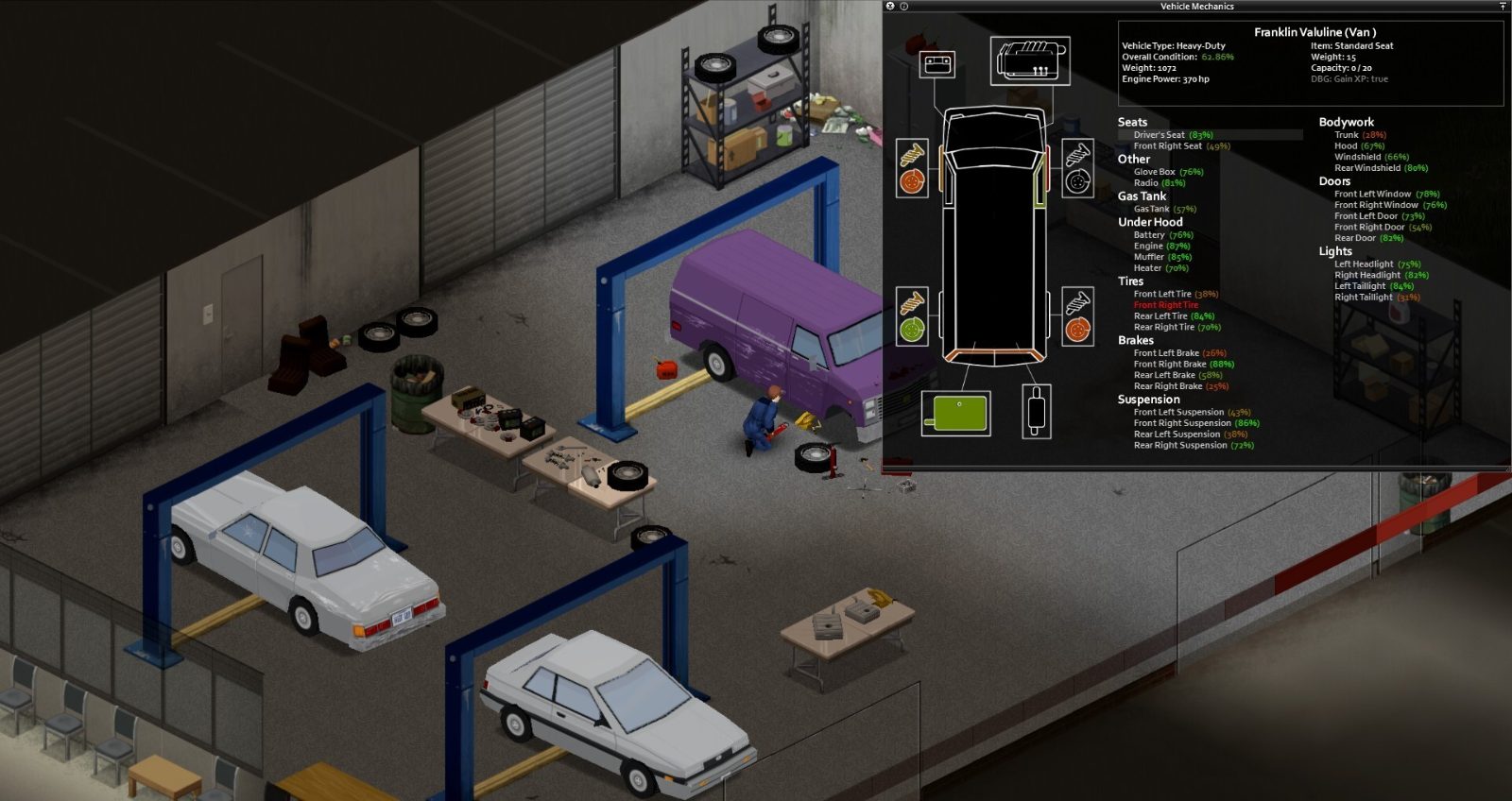
A mechanic's garage with cars on lifts
Workstations: where the real crafting happens
01Step

How crafting works now
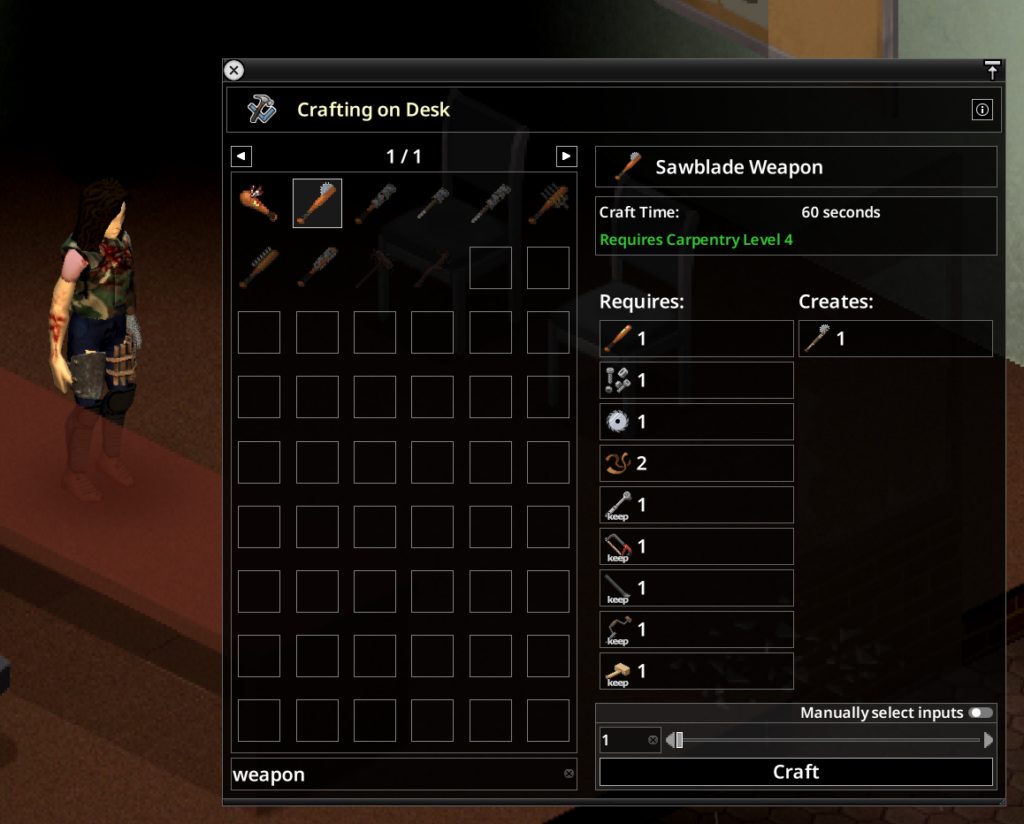
The crafting window
The crafting window: pick ingredients and see requirements · Official image, The Indie Stone
  • One crafting window. Search by what you have or what you want to make. Filters narrow it down, and a Favourites tab keeps your regulars close.
  • Choose your ingredients. When a recipe accepts several inputs, you pick which one to use, so you are not forced to burn your best materials.
  • Craft in bulk. Make several of an item in one go. When everything is in place, right-click shortcuts skip the window entirely.
  • Workstations matter. Simple things are made from your hands and bag. Anything serious needs a surface or a device: a workbench, a furnace, a kiln, an anvil.

Since 42.21 you can also search inside workstation menus, and the game tells you when a search finds no recipes instead of showing an empty list.
02Step

The crafting skills

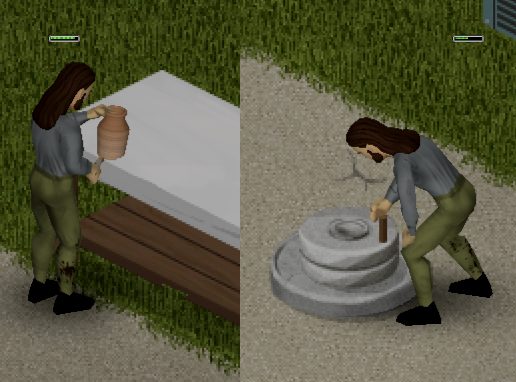
Pottery and milling
Pottery and a hand mill · Official image, The Indie Stone
Carving

Knives, whittled tools and simple weapons from wood and bone. The earliest craft of all.

Knapping

Stone tools and blades from flint and rock. Pairs with carving for a from-nothing start.

Masonry

Stone and clay walls, furnaces and kilns. The foundation of a long-term base.

Blacksmithing

Forged tools, weapons and parts at an anvil. The deepest tree in Build 42.

Tailoring

Repairs and patches for clothing. Since 42.16, XP comes from making items, not grinding patches.

Welding

Metal structures and repairs with a welding torch and mask.

Carpentry

Still the backbone: planks, walls, furniture, rain collectors, barricades.

Pottery

Clay vessels, fired in a kiln, for storage and cooking.

Occupations give you a head start: a Blacksmith starts with Blacksmithing, a Welder with Welding recipes (fixed in 42.21), a Carpenter with real Carpentry since the 42.16 rework.

03Step

Workstations

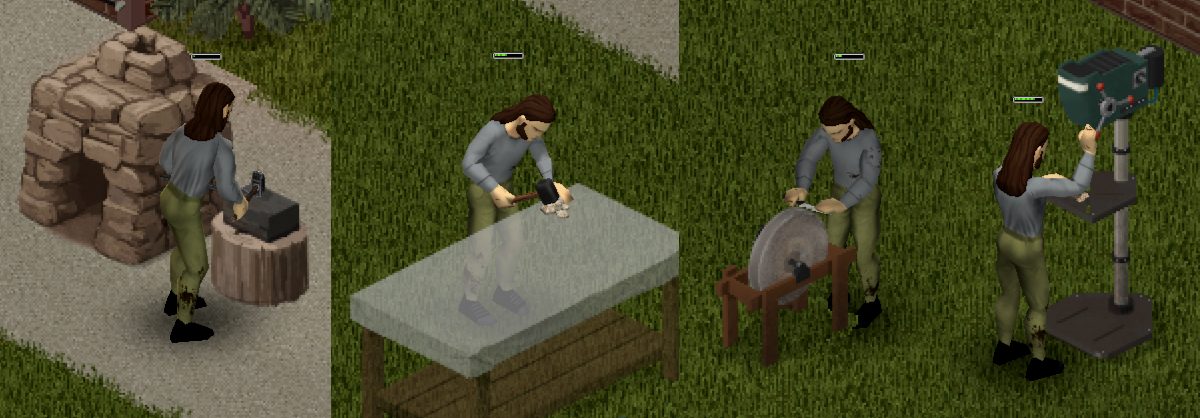
Four crafting stations in use
Forge, table, grindstone and drill press · Official image, The Indie Stone
  • Found in the world: kitchen counters, workbenches in garages, forges in some rural buildings. Right-click one to see what it can make.
  • Built by you: from a simple crafting table up to stone furnaces and kilns, as your Carpentry and Masonry grow.
  • Fuel and heat: furnaces, kilns and campfires need fuel and time. Charcoal, made in a charcoal pit from logs, burns hotter than wood.
  • Drying racks and shelters are workstations too: they turn hides, meat and crops into materials and food that keep.

Build workstations near your storage. Crafting pulls from nearby containers, so a tidy workshop saves hours of carrying.

04Step

From sticks to steel

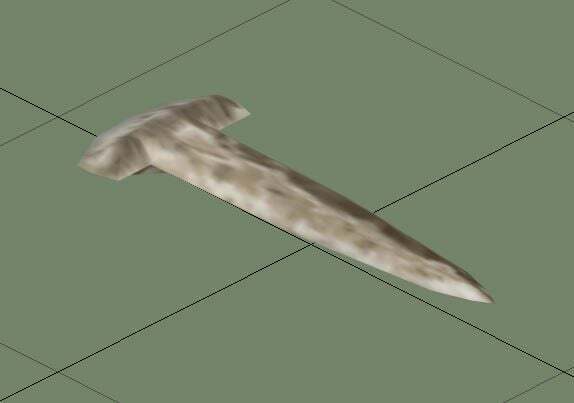
A knapped stone axe head
A knapped stone axe head · Official image, The Indie Stone
  1. Day one: sharpen a stick into a spear, carve a wooden mallet, knap a stone knife and axe. All of it from branches, rocks and flint off the ground.
  2. First week: a hammer, saw and nails unlock carpentry. Planks become walls, crates, barricades and rain collectors.
  3. First month: clay from riverbanks and a kiln give you pottery and clay walls. A charcoal pit feeds a stone furnace.
  4. Long term: scrap metal and iron into a furnace, then an anvil and blacksmithing: forged tools, weapon heads, armour. Welding joins and repairs metal.

You do not have to climb the whole ladder. Many survivors stop at carpentry and loot the rest. The deep tree is there for when the loot runs out.

05Step

Weapon condition in Build 42

  • Some melee weapons now track the handle and head separately, plus the sharpness of any blade.
  • Heads can fly off a worn weapon. A broken spear can still be used as a weaker weapon.
  • Sharpen blades on a whetstone, and replace a cracked handle instead of binning the whole tool.
  • Maintenance skill slows wear. The Tinkerer trait, new in 42.16, gives +1 Maintenance.
06Step

Learning recipes

  • Skill books multiply the XP you earn. Read the matching volume before you grind.
  • Magazines teach specific recipes, from generators to advanced cures and crafts.
  • VHS tapes teach skills on a TV. Tapes for Blacksmithing, Welding, Knapping, Pottery, Tailoring, Electrical, First Aid, Aiming and Animal Care arrived in 42.17.
  • Occupations and traits start you with recipes you would otherwise have to find.

Sit down to read: it is faster since 42.15.

+Ref

The six crafting disciplines

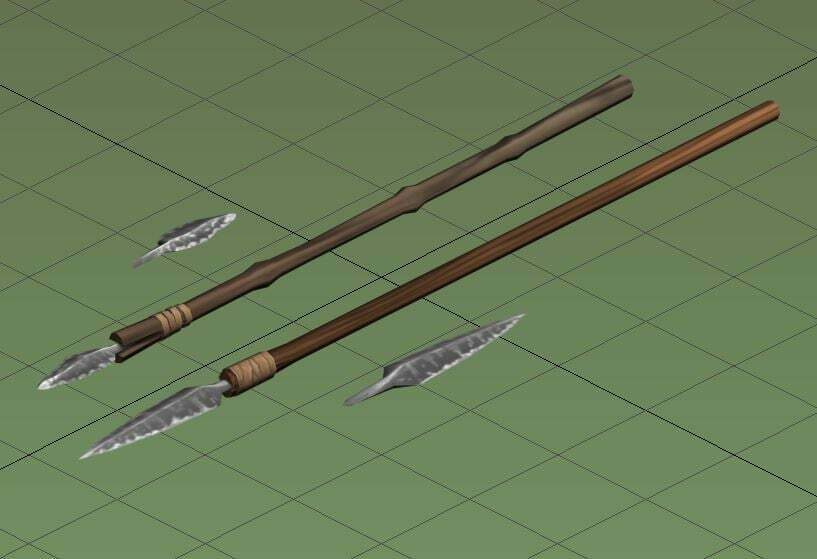
Carved spears and knapped heads
Carving and knapping: spears and stone heads · Official image, The Indie Stone

Beyond the early tools, Build 42 crafting splits into disciplines. Each has its own stations, materials and skills.

Pottery

Clay collection, wheel throwing and kiln firing.

Metal forging

From primitive to advanced metalworking.

Stone working

Quarrying and shaping stone.

Brewing

Fermentation and distillation.

Leatherworking

Hide processing, armour and clothing.

Weapon crafting

Melee weapons made from raw materials.

+Ref

Machine tiers: primitive, intermediate, advanced

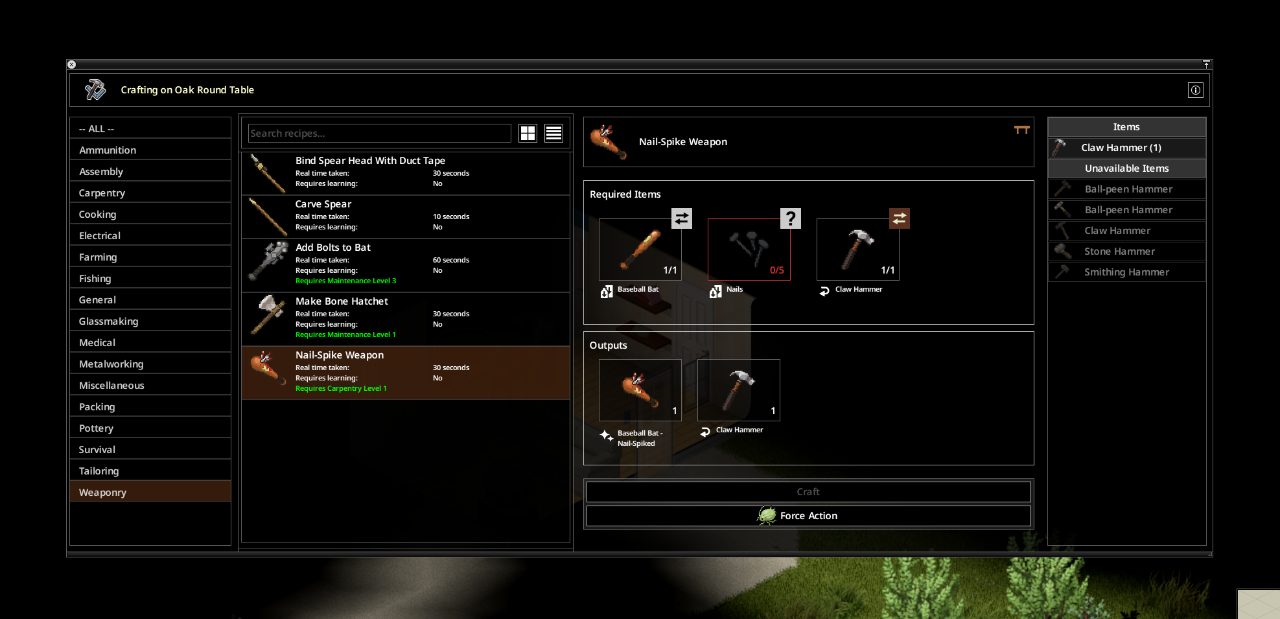
A crafting menu
Recipes show what you need up front · Official image, The Indie Stone
Primitive

Stone furnaces and basic kilns that you can build from found materials.

Intermediate

Improved forges and wheels. They need moderate skill and resources.

Advanced

Electric kilns and powered tools. These are found rather than built, and need power.

Generators are outdoor-only. Running one in a sealed room fills it with lethal exhaust.

+Ref

Crafting chains and tiers

  • Multi-step chains. Station chains cover carpentry, masonry, metal and blacksmithing. Planks become nailed furniture, and scrap metal becomes station work.
  • Mechanics recipes come in Basic, Intermediate and Advanced tiers.
  • Welding is not blacksmithing. Welding covers torches, barricades and scrap work. Blacksmithing is separate forge work. The live skill is called Welding, not "Metalworking".
  • Research and recipe flow. The craft window lets you look up what you can make and what you are missing.
  • Log one chain early. Craft one simple chain from start to finish on day one to learn the interface.
+Ref

Rain collectors and water

  • A rain collector crate needs Woodwork 3. A barrel needs Woodwork 5.
  • Put collectors where gutters and rooftops can feed them, and keep containers for the dry months.
  • Boil or purify any water that is not from a sealed bottle or tap.

Do not confuse Woodwork with the older name "Carpentry" in guides. Check the skill level in your own Skills panel.

+Ref

A crafting plan for your first month

Week 1

Hammer, saw, screwdriver, knife. Barricades and a rain collector if you can.

Week 2

Read skill books. Start a station near your storage. Try one carving or knapping recipe.

Week 3

Make charcoal, learn one new recipe from a magazine, and repair weapons rather than replacing them.

Week 4

Choose a long-term discipline: masonry for walls, leather for clothing, metal for tools.

+Ref

Woodwork recipes that level you

Wood floor

Woodwork 1. Hammer, 1 plank, 1 nail. 10 XP.

Wooden pole

Woodwork 2. Hammer, 1 plank, 1 nail. 20 XP. A compact XP source.

Rain collector (bag)

Woodwork 3. Hammer, 4 planks, 4 nails, 4 garbage bags.

Rain collector (tarp)

Woodwork 3. Hammer, 4 planks, 4 nails, 1 tarp.

Basic crate

Woodwork 3. Hammer, 4 planks, 4 nails. 30 XP.

Build floors and low furniture until Woodwork 2, then switch to poles. On the four stock presets, dismantling furniture gives no Woodwork XP because the dismantle cutoff is 0.

+Ref

Books vs magazines

  • Skill books raise your XP multiplier for a level band. They do not teach recipes. Carpentry, Cooking and Maintenance each have books I to V.
  • Recipe magazines unlock specific recipes. Smithing Mag 1 includes Make Crude Whetstone, tongs, nails and several forge tools.
  • Make Crude Whetstone needs Maintenance 1, learns itself at Maintenance 2, costs 2 stone and gives 5 Maintenance XP.
  • Pick Thread needs Tailoring 1, rips or denim strips, and a needle, tweezers or awl. Tearing clothing does not give thread.
  • Electrical levels mainly from dismantling electronics. Generator knowledge comes from the Electronics magazine or certain occupations.
+Ref

Metalworking, smithing and welding

  • Stations: forge, furnace, kiln and a charcoal supply.
  • Charcoal is made in a pit or a barrel. Keep it next to the forge so you do not run short.
  • Process: smelt scrap metal into stock, then forge tools and weapon parts. Read the smithing magazines first.
  • Propane welding needs a torch, fuel and a welder's mask. Metal sheets and pipes come from dismantling wrecks.
  • Masonry uses chisels, trowels, clay, brick and cement-style materials. Starter tools can be forged or knapped.
  • Glassmaking needs sand, clay tooling, furnace heat and moulds.
  • Pottery needs a bench or wheel (which needs Carpentry), clay from near wet ground, and a kiln for firing. Crucibles and storage vessels unlock other industries.
+Ref

What each skill band gets you

Levels 1 to 3

Basic wood structures, early storage, simple water collection and starter stations.

Levels 4 to 6

Stronger barriers, specialised craft rooms, and more reliable food and water.

Levels 7 to 10

Heavy fortification, advanced production and quality-of-life systems.

Values change between patches. Check the live craft menu for exact costs before you commit materials.

+Ref

Tailoring in detail

Patch a hole

Closes the hole and adds protection.

Add padding

A patch on an intact part for extra protection.

Full restore

Removes the hole and restores condition. Needs Tailoring 8 and the same fabric (cotton on cotton, denim on denim, leather on leather).

Protection per patch

Cotton (ripped sheets)

Scratch +1% at level 1, +2% at 5, +5% at 10. No bite protection.

Denim strips

Scratch +1 / +5 / +10%. Bite +1 / +2 / +5%.

Leather strips

Scratch +2 / +10 / +20%. Bite +1 / +5 / +10%.

  • A spool of thread does about 20 patches. Needles and scissors wear out, so keep spares.
  • Pick Thread (Tailoring 1) turns a sheet or denim strip into thread with a needle, tweezers or awl.
  • Adding a patch gives 2 XP. Removing one gives 2 XP if you get the fabric back (10% plus 5% per level, up to 60%).
  • A hole removes all protection from that body part until fixed.
  • Helmets and hard armour cannot be patched.
  • From 0 to 10 takes 21,850 base XP. Read Tailoring books first.
+Ref

Electrical in detail

Small electronics

Dismantle cameras, watches, flashlights, CD players, alarms, remotes and speakers with a screwdriver: 2 XP each.

TVs and radios

Dismantle TVs, radios, walkie-talkies and ham radios: 10 XP each.

Appliances

Scrap electric furniture for 5, 10 or 15 XP by size.

Generator repair

5 XP per Electronics Scrap.

Improvised flashlight or lantern

10 XP. Electrical 1 and the Sparky's Lighting Guide magazine.

Makeshift radio, walkie-talkie, ham radio

10, 20 and 30 XP. Electrical 1, 2 and 3 plus radio magazines.

Magazines

Electronics Mag 1 to 5

Remote controllers and triggers, timers, motion sensors, generators, improvised lights.

Engineer Mag 1 to 3

Noise makers and firecrackers, smoke bombs and gas-mask filters, homemade explosives.

Radio Mag 1 to 3

Makeshift radio, walkie-talkie and ham radio.

Electrician starts at Electrical 5 with generator knowledge. Engineer starts at 1 with generators and explosives.

+Avoid

Common crafting mistakes

  1. Crafting with your best material when a cheaper one works. Check the ingredient choice first.
  2. Building workstations far from your storage, then hauling loot back and forth.
  3. Practising a skill before reading its skill book.
  4. Crafting noisily with zombies nearby. Hammering and sawing carry.
  5. Leaving tools at home. Carry a hammer, saw and knife on every trip.
  6. Replacing a worn weapon when you could repair or sharpen it.
07Q&A

Quick answers

Do I need the new skills to survive?

No. Carpentry, cooking and first aid carry most runs. The deep crafting tree is for self-sufficiency when the loot runs out.

Why can't I craft something I have the materials for?

Most advanced recipes need a workstation, a skill level, or a recipe you have not learned yet. The crafting window shows which is missing.

What is the best first crafting skill?

Carpentry. It builds your base, your storage, your barricades and your rain collectors.