Latest
Oct 27 · 42.22 pre-release: ladders and crowbar break-insOct 21 · The Indie Stone on Java mods: download responsiblySep 28 · Build 42.21 Stable: zombie duplication fixesAug 26 · Security fixes on every branchAug 17 · Servers now handle up to 254 playersJul 29 · Build 42 goes Stable

The Project Zomboid beginner's guide

Everything a new survivor needs for Build 42, in the order you need it: from setting up your first world to getting through your first week. No spoilers, no jargon, just what keeps you alive. Updated for Build 42.21, November 2026. New to the keys? Start with the controls page.

00Step

The one rule that matters

Project Zomboid tells you on the first screen: this is how you died. Every run ends. The goal is to make yours last, and the single biggest killer of new players is a zombie bite.

A bite is a death sentence. On default settings, a zombie bite always passes on the Knox infection, and there is no cure. Scratches and lacerations carry a smaller chance. Everything in this guide is really about not getting bitten.

The other big killers, in order: fighting while tired, getting surrounded, making noise, and running out of water when the taps stop. We cover all four.
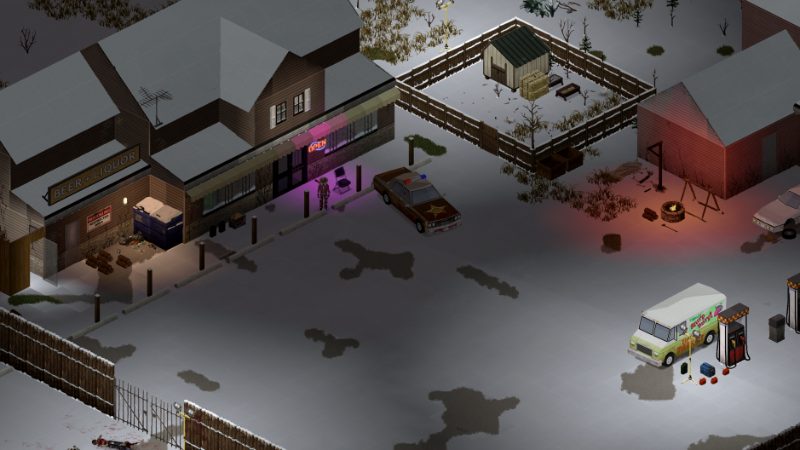
01Step

Pick a game mode and set up your world

Build 42 has four ready-made game modes, rebuilt in March 2026. Pick one on the New Game screen; each also exists as a preset in Custom Sandbox if you want to tweak it.

RisingBest first game

A cozier mode with less focus on combat and more materials, for exploring and building. Still deadly.

ApocalypseThe real thing

The "lore canon" mode: what really happened in Knox County. No zombie respawn, more guns in the world.

OutbreakLess grind

Faster skills, farming and loot, for players with less time. Challenging if you overreach.

ExtinctionVeterans only

Sprinting zombies, day and night, and scarce supplies. The studio says it is not for your first game.

Custom Sandbox tweaks for learning

  • Zombie population: low or normal gives you time to learn.
  • Water and electricity shutoff: push them later so you are not rushed.
  • Zombie respawn: off, so cleared streets stay clear (already off in Apocalypse).
  • Loot: leave it at normal. Abundant loot teaches bad habits.

Once you can survive two weeks in Rising, move to Apocalypse. That is the canon game.

An isometric view of a small Knox Country town street with houses and parked cars
Knox Country · Official screenshot, The Indie Stone
02Step

Pick a starting town

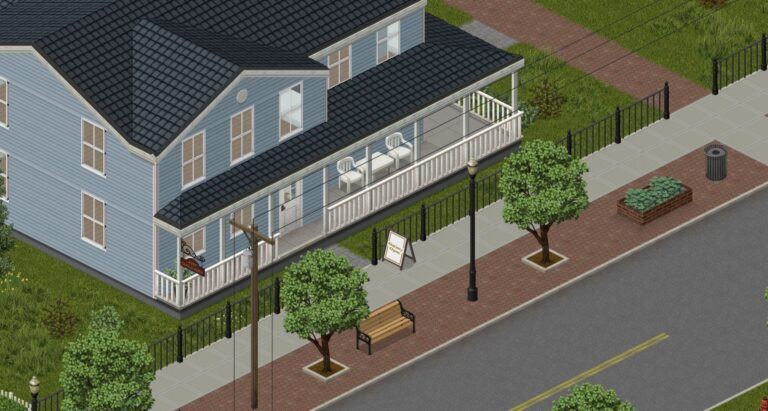
A blue house with a porch
Pick a quiet house with few entrances · Official image, The Indie Stone

Where you spawn matters more than your character. Quieter towns give you time to loot, read and build. The four classic starting towns support every occupation's special spawn; Sandbox games can also start in newer towns like Brandenburg, Ekron, Irvington, Fallas Lake, March Ridge and Valley Station.

RiversideEasier

Spread-out houses, good riverside homes and room to breathe.

RosewoodEasier

Small and quiet, with a fire station and police station close together.

MuldraughMedium

Dense housing and plenty of loot, with more zombies on the streets.

West PointHarder

A big, busy town. Great loot, but crowds come fast.

Riverside, Rosewood, Muldraugh and West Point were all reworked in Build 42's Map Glowup, so even veterans will find new streets. Leave the big city of Louisville for much later.

03Step

Build your character

You get points from an occupation and spend them on traits. Taking negative traits gives you more points, but pick ones you can live with.

Good first occupations

  • Firefighter, Police Officer, Park Ranger: solid all-rounders with fitness, combat or outdoor skills. (Firefighter was called Fire Officer before Build 42.16.)
  • Carpenter or Construction Worker: easier barricades and base building from day one.
  • Custom Occupation (was Unemployed): no skills, but the most points for traits (+8). Every job and trait is on traits and occupations.

Traits beginners love

  • Strong or Stout: hit harder, carry more, knock zombies down easier.
  • Organized: bags and boxes hold more.
  • Fast Learner: skills level up quicker.
  • Keen Hearing and Cat's Eyes: spot danger sooner.
  • Tinkerer or Target Shooter: new in Build 42, a cheap +1 to Maintenance or Aiming.

Traits to avoid early

  • Smoker (you will need cigarettes), Clumsy, Slow Reader, Weak and Prone to Illness.

Occupations and traits were reworked in 42.16 and tweaked again in 42.17 to 42.19. Check the numbers on the character screen, not an old guide.

04Step

Controls that keep you alive

Default PC controls. You can change any of them in Options → Keybinds.

Right mouseHold to aim and get ready to fight
Left mouseAttack while aiming
SpaceShove a zombie away, or stomp one on the ground
CSneak (crouch): quieter and harder to spot
ShiftRun
AltSprint: fast, but burns endurance
EInteract: doors, windows, curtains
MMap

Shove and stomp are your best friends. Shoving costs nothing and knocks zombies over; stomping a downed zombie saves wear on your weapon.

05Step

Your first day, hour by hour

  1. Minute one. Pause and look around. Close the curtains in your spawn house and lock the doors.
  2. First hour. Search every room of your house: a weapon (a kitchen knife, a hammer, a frying pan, anything), a bag, food and water.
  3. Morning. Loot your street one house at a time. Sneak, look through windows, and leave any house with more than one or two zombies inside.
  4. Afternoon. Upgrade your weapon. A baseball bat, crowbar or axe is a huge step up. Find a hammer, saw and nails for later.
  5. Evening. Pick a base (see Step 08), fill every bottle and pot with water, and eat the food that will spoil first.
  6. Night. Stay inside, read, and sleep with the curtains closed and lights low. Light and noise draw zombies.
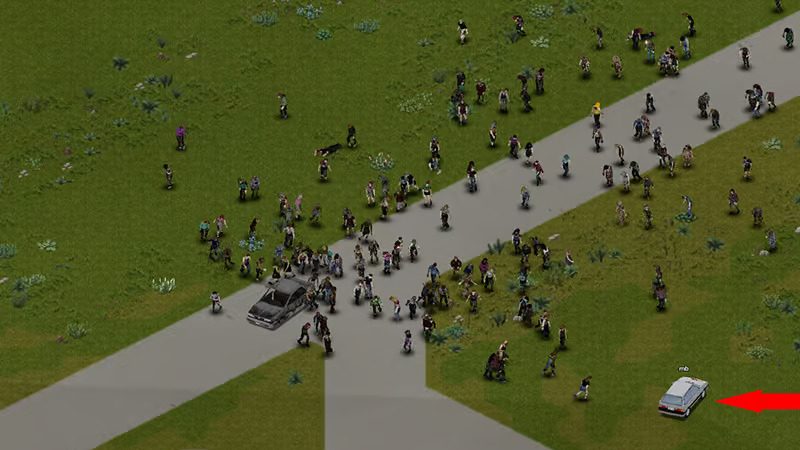
A large horde of zombies spread across an open field
What a horde looks like from a safe distance · Official screenshot, The Indie Stone
06Step

Fighting without dying

  • One at a time. Two zombies are dangerous. Three or more: leave.
  • Use doors and fences. Fight through a doorway so they come one by one. Zombies climbing a fence fall over, ready for a stomp.
  • Watch your endurance. Swinging and running tire you out. A tired survivor misses, staggers and gets bitten. Back off and rest.
  • Keep calm. Panic makes you worse at fighting. Avoid big crowds until you are confident.
  • Mind your weapon. Weapons wear out and break. Carry a spare.
  • Guns are loud. Every shot calls zombies from far away. Save them for emergencies.
  • Never fight in the dark if you can avoid it. You cannot see what is coming.
07Step

Wounds, sickness and the Knox infection

Open the Health panel after every fight. Treat wounds as soon as you are safe.

Scratch

Small chance of the Knox infection. Clean it and bandage it.

Laceration

A bigger chance than a scratch. Bandage quickly to stop the bleeding.

Bite

On default settings, always the Knox infection. Put your affairs in order.

Glass or bullet

Remove it with tweezers before bandaging.

  • Disinfect first. Use disinfectant, alcohol wipes or strong alcohol, then a clean bandage. Change dirty bandages.
  • Infected wound is not the zombie infection. It is an ordinary infection that clears up with rest, food and clean bandages.
  • Feeling queasy? It could be bad food, a cold, or the end. Raw or spoiled food is the usual cause early on.
08Step

Your first week

Want the full plan? Read the day-by-day first week survival guide.

Pick a base

  • A house with few doors, curtains on every window and a second floor.
  • Keep an escape route: tie sheets into a sheet rope and hang it from an upstairs window.
  • Barricade ground-floor windows with a hammer, nails and planks when you have them.

Water and power

  • The taps and the electricity will stop. Fill every bottle, pot and bathtub before they do.
  • Eat fridge and freezer food first. When the power goes, it starts to spoil.
  • Plan for later: rain collectors for water, and a generator, which needs its magazine read before you can use it.

Get smarter

  • Skill books make you learn much faster. Read them before you practise, and sit down to read: it is quicker.
  • Skill VHS tapes on a TV teach skills too, from First Aid to Welding.
  • Magazines teach recipes, like generators and rain collectors. Grab any you find.
  • Keep a pencil and mark stores, gas stations and danger zones on your map.

The helicopter

Sometime early on, a helicopter will fly over and drag every zombie for miles behind it. When you hear it, get indoors and stay quiet until it passes.

09Step

Eat, drink and stay healthy

Hunger and thirst kill slowly and make everything else worse first: a hungry survivor heals slower and carries less, a thirsty one fights badly. Keep both moodles off the screen and half your problems disappear.

Water

  • While the taps run, every sink, bath and toilet is a free refill. Drink from them directly or fill bottles.
  • When the water shuts off, river and lake water, rain barrels and anything from a rain collector is tainted: drinking it makes you sick. Boil it first in a pot or kettle on a stove or campfire.
  • Carry one water bottle at all times. A thirsty survivor takes stupid risks.

Food

  • Perishables first. Fresh meat, milk, eggs and vegetables rot in days, faster with no power. Canned, dried and packet food keeps for months; save it.
  • Cook raw meat and fish. Raw meat gives food poisoning, and so does anything rotten. A cooking pot, frying pan or baking tray on a working stove, or a campfire outside, is enough. Set a timer in your head: food burns if you walk away.
  • One hot meal a day beats snacking. A soup or stew in a pot feeds you for days and uses up vegetables before they turn. The cooking guide has the recipes; the food list has every food's calories and spoil time.
  • Calories matter over weeks, not hours. Live on crisps and chocolate and you gain weight; live on lettuce and you waste away. Both cost you fitness. Watch the weight on the info panel (J).

Rest and sleep

  • Sleep in a bed when you can. A couch is fine; the floor is not. You wake up in the night if you are in pain, so bandage before bed.
  • Tired moodles cut your damage and awareness. If you are Very Tired, you are not clearing that house today.
  • Reading, sitting and cooking all pass time quickly and safely. Use the dead hours after dark for them.

Food poisoning, a cold and the Knox infection all start with the same Queasy moodle. If you have not been scratched or bitten in the last day, it is almost certainly the food. Rest, drink, and stop eating whatever did it.

10Step

Looting: where things are

You cannot carry a town, so loot with a purpose. The first week has a shopping list, and every building type sells something different.

Houses

Kitchen knives, frying pans, hammers, bags, food, sheets, water. Bedrooms hide bags and pillow cases; garages hide saws, nails and sometimes an axe.

Garages and sheds

Tools, nails, planks, gas cans and the occasional car battery. Quiet, few zombies, and often the best early weapon upgrade.

Fire stations

Axes, fire axes, firefighter gear that resists bites, and a lot of room. The classic first base in Rosewood.

Police stations

Pistols, shotguns, ammo and police armour. Also a crowd: police stations draw big groups, so clear the street before the building.

Warehouses and workshops

Nails, planks, metal, wire, propane tanks and the heavy tools. Dark inside: bring a torch.

Schools and libraries

Skill books by the shelf, magazines, pens and paper. Low food, high value.

Gun stores and hunting shops

Rifles, ammo, hunting gear and traps, behind the biggest crowds in any town.

Pharmacies and clinics

Bandages, disinfectant, painkillers, antibiotics and suture kits. Grab tweezers and a needle here too.

Gas stations

Gas, maps, snacks, and the pumps work while the power is on. Fill cans early; without power you need a generator at the pump.

Farms and the woods

Seeds, trowels, watering cans, and in Build 42 the animals. Foraging in Search Mode (End key) finds berries, mushrooms, stones and sticks anywhere outdoors.

How to loot a house

  1. Look first. Walk round the outside and look through the windows. Two zombies inside: come back later.
  2. Go in quietly. Open doors; do not smash windows. Close the door behind you so nothing follows you in.
  3. Clear it room by room. Zombies in cupboards and bathrooms wake up when you walk past. Weapon ready, swing first.
  4. Search every container, including the ones that look empty. Then the car outside, the bins and the shed.
  5. Leave the junk. Weight slows you down and heavy load is how people get caught. Take what is on the list and come back for the rest with a car or a wheelbarrow.

Bags go on your back, not in your hands. A school bag or duffel bag doubles what you can carry; a hiking bag triples it. Every bag and every loot location is listed in the wiki.

11Step

Stealth: how zombies find you

Zombies have eyes and ears, and most new survivors die to the ears. Understand what they notice and you can walk through a town that would eat a careless player.

Sight

  • Zombies see in a cone in front of them. Walk behind a zombie and it has no idea. Walk in front of it at any distance it can make out and it turns.
  • Sneaking (C) makes you harder to spot, especially behind fences, cars and bushes. Sneak whenever you are near them, walk when you are not.
  • At night they see less, and so do you. A lit window with open curtains is a beacon.

Sound

  • Running is louder than walking, sprinting louder still. Fighting is loud. Breaking glass is very loud. A gun or a car alarm is heard across the town.
  • Some houses have alarms. If one goes off when you open the door, leave immediately and come back in an hour when the crowd has thinned out.
  • Shouting (Q) pulls zombies toward you. That is useful when you want to draw a few away from a building, and fatal when you hit it by mistake.

Getting away

  • Break line of sight. Go round a corner, through a house and out the back door; zombies lose you when they cannot see you.
  • Zombies climb fences slowly and fall over on the far side. A tall fence with a gap in it is a kill lane; a low fence is a speed bump for you and a trap for them.
  • Never run into the dark. Walk, keep your endurance, and stop to listen.

The helicopter, gunshots in the distance and screams at night are the game moving zombies around. A street that was clear yesterday can be full today. Look before you leave the base, every single time.

12Step

Your base, set up right

A base is where you sleep without one eye open. It does not need walls on day one; it needs curtains, a second floor and a way out.

Day one

  • Close every curtain and sheet every bare window. Zombies that cannot see you do not come to the house.
  • Lock the doors. Shut the ones you are not using. A zombie that bangs on a door gives you time; one that walks in does not.
  • Hang a sheet rope from an upstairs window: a sheet and a nail, or ripped sheets tied together. It is your exit when the front door fails.
  • Move corpses away from the house. In Build 42 a pile of bodies brings the Noxious Smell moodle and sickness; drag them to the road or burn them with gas and a lighter, downwind.

Week one

  • Barricade the ground-floor windows with planks, nails and a hammer, from the inside. Leave one window and the upstairs rope as exits.
  • Store water: fill every bottle, pot and the bath. Then build a rain collector from planks, nails and bin bags once you have read the magazine, and boil what it catches.
  • Put a sleeping bag or mattress upstairs. Sleep up there with the stairs clear and the rope ready.
  • Make a crate or two for storage and sort your loot. Keep the bug-out bag by the rope: water, food, a weapon, bandages, a map.

Later

  • A generator (read the magazine first) keeps the fridge, lights and the gas pump alive, and it is loud and poisonous indoors. Run it outside or in a shed.
  • Carpentry, then walls and gates, then a farm and animals. The base building page covers all of it.

A daily routine that works

Morning

Eat, drink, check wounds and moodles, pick one target for the day. Leave with an empty bag.

Midday

Loot or clear, one building at a time. Home before you are tired, not after.

Afternoon

Drop loot, cook, fill water, repair the weapon, sort the crate.

Evening

Read a skill book by the window while there is light. Curtains closed before dark.

Night

Sleep upstairs. If you cannot sleep, read or craft. Never go out.

Zombies find a base because of noise and light, not because it exists. A quiet, dark house in a quiet street survives months. A loud one with a generator in the kitchen does not.

13Step

Weather, seasons and the clock

The game starts in July. It is hot, the days are long and food rots fast. That gives you about three months to get ready for the part that kills most long runs: winter.

Summer (start)

Heat and thirst. Wear light clothes, carry water, and do your running early and late in the day. Thunderstorms soak you.

Autumn

The best season: cool, long harvests, foraging at its richest. Fill crates, stack firewood, find a winter coat.

Winter

Freezing nights, short days, snow that slows you and hides zombies. Wet clothes and cold together are deadly; so is a house with no heat. Keep a fire, keep dry, go out less.

Spring

Rain, mud and fog. Visibility drops and so does yours. Crops go in now for a summer harvest.

Rain and wet

  • Rain makes you Wet, then Cold, then sick. Wear a raincoat or stay in, and dry off by a fire or a working heater.
  • Fog hides zombies until they are on you. Fog days are reading days.

The clock

  • An in-game day passes in about an hour at normal speed. The fast-forward keys (F2 to F6) are for reading, cooking and waiting out the night, never for walking somewhere.
  • Time does not stop while you read or craft. Check the window every chapter.
  • Water and power shut off at some point in the first month. The day it happens, every tap and fridge in Knox Country stops at once.

Your first winter is a project, not a surprise. From September on, every trip should bring home something warm, something canned or a piece of firewood. The clothing page shows which coats keep the cold out.

14Step

When it all goes wrong

Bitten

On default settings you have a few days. Use it: carry your best loot to your base and write where it is in the journal, or set up a bed and a farewell. In Sandbox you can turn Transmission to Saliva Only or None before you start if you would rather not play with the death sentence.

Scratched or cut

Not a death sentence, but a lottery. Disinfect, bandage, and stay somewhere safe for two days. If you get sick and the Queasy climbs, it was the lottery. If not, you are fine.

Surrounded

Do not fight. Shove the nearest zombie, run through the gap and break line of sight. A house with two doors is an escape route; a dead end is a grave.

Caught in the dark

Stop. Crouch. Listen. Walk, do not run, toward the nearest building you know and sleep there. Night is for staying put.

Out of water

Rivers and lakes are on the map, and rain fills a bucket or a pot left outside. Boil everything. Beer and juice from any kitchen will get you through a day.

Lost

Open the map (M). Roads lead to towns; rivers lead to Riverside and West Point; rail lines run between the big towns. Follow one of them, in daylight, at a walk.

Sick

Rest, eat, drink and stay warm, indoors, for two or three days. A cold passes. Food poisoning passes. Knox does not, so you will know.

Car will not start

Keys first: ignition, glovebox, the zombie that owned it, the house next to it. Then the battery, then gas. The vehicles guide covers hotwiring and repairs.

Every run ends. The one that lasted a month taught you more than the ten that lasted a day, and the next one starts with everything you learned. That is the whole game.

15Step

Ten mistakes every new survivor makes

  1. Sprinting everywhere and arriving exhausted.
  2. Fighting a group instead of walking away.
  3. Leaving curtains open with the lights on at night.
  4. Smashing windows to get in. Noise, and glass cuts.
  5. Ignoring a scratch until it gets infected.
  6. Carrying too much and moving slowly.
  7. Waiting too long to store water.
  8. Looting in the dark without a flashlight.
  9. Starting a car next to a crowd. Engines and alarms are loud.
  10. Forgetting to eat, drink and sleep. Moodles matter.
16Step

Moodles: the icons on the right of your screen

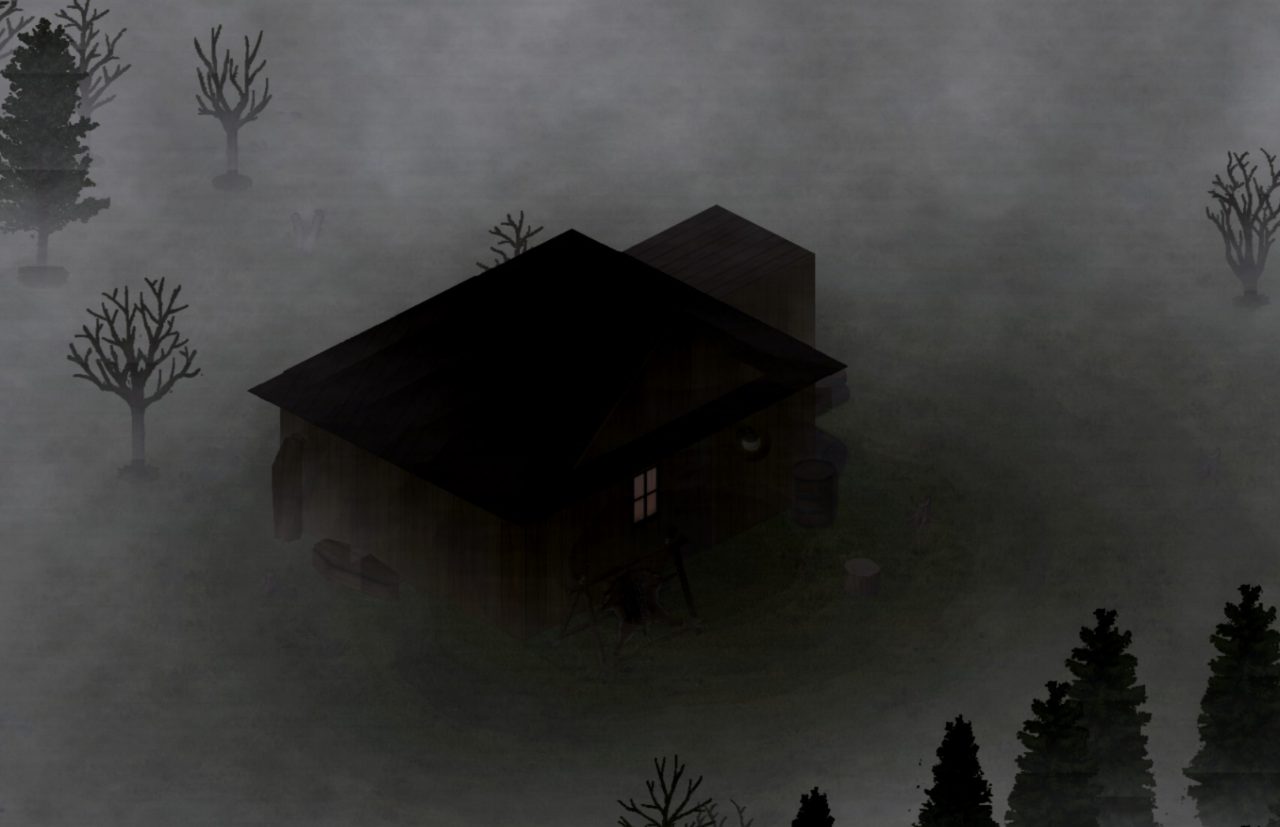
A house in fog
Fog and night raise panic · Official image, The Indie Stone

Moodles are the small icons that show how your character feels. Each has levels, from a mild warning to a crisis. Treat them like dashboard lights: fix the cause while the level is low.

Endurance

Drops when you run, swing weapons or push yourself. At low levels you tire fast; at the worst you can barely walk. Break line of sight, rest, and fight again only when recovered.

Tiredness

Grows the longer you stay awake. Strength and clear thinking fall at higher levels. Sleep somewhere safe; coffee does not replace sleep.

Panic

Triggered by open streets and big groups of zombies. Reloading slows and gun accuracy suffers. Get indoors or behind cover and break line of sight.

Stress

Builds in bad fights and hot zones, and stacks with panic. Leave the area and calm down before opening the next door.

Pain

From wounds and hits. Makes it hard to focus. Bandage wounds, take painkillers if you have them, and avoid fighting until it eases.

Hunger and thirst

Warnings start early, then become "Very Hungry" or "Parched". Drink first, carry a bottle, and eat before long trips.

Sick and temperature

Illness, heat, cold and the wrong clothing all show up here. Change layers, warm up or cool down, and rest.

Heavy load

You are carrying too much. Movement slows, and at high levels you nearly stop. Drop loot before you fight.

Drunk and unhappy

Both slow down timed actions. Drunk also hurts coordination. Both fade over time.

Servers and sandbox settings can scale how hard panic and other moodles hit your aim with firearms. Melee is not affected by that setting.

17Step

Zombie speeds: shamblers, fast shamblers and sprinters

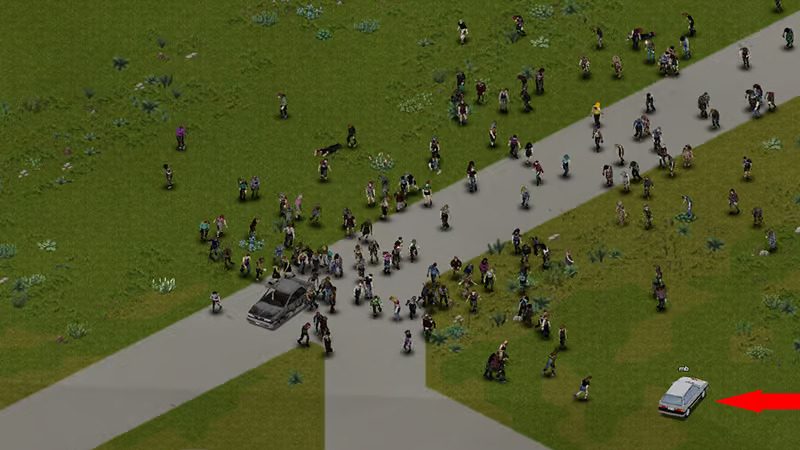
A horde crossing a field
A horde on the move · Official image, The Indie Stone

Speed is set in Sandbox under Zombie Lore, and it changes how the whole game plays. Check it before you pick a strategy.

Shamblers

The slowest upright speed. You can walk away, kite groups and recover between fights.

Fast shamblers

Brisk walkers. A common middle setting if you do not want pure runners.

Sprinters

Every zombie moves at sprint speed. Escapes and long fights get much harder.

Random

A mix of speeds. A second option, Random Sprinter Amount, sets what share of zombies sprint (choices include 100, 90, 50, 33, 6 and 0 percent).

The ready-made game modes set this for you: Rising uses shamblers, Apocalypse and Outbreak use Random with no sprinters, and Extinction uses Random with about 6 percent sprinters. Crawlers are not a speed setting. They are zombies on the ground after taking leg damage, and they can still grab your ankles.

Zombies also gather in idle groups outdoors. The Rally Group Size setting only controls how big those clusters are; it does not change how many sprinters there are.

18Step

Glossary: the words everyone uses

Knox infection

The virus behind the outbreak. Bites pass it on and there is no cure on default settings.

Moodle

A status icon for how your character feels. See above.

Sandbox

The settings screen where you change zombie speed, loot, weather, shut-off dates and more.

Stable, Unstable, Legacy

Release branches. Stable is the tested version, Unstable gets new features first, Legacy is the old Build 41 line.

Workshop

Steam's mod library for Project Zomboid.

Kiting

Leading zombies around and fighting them in small numbers instead of all at once.

Barricading

Planks and nails on windows and doors to slow zombies down.

Sheet rope

A rope made from bedsheets, tied to a window as an emergency exit.

Hotwiring

Starting a car without keys. Needs the right skills; see the vehicles guide.

Skill book

A book that speeds up XP gain for one skill. Read it before you practise that skill.

Loot

Anything you pick up, from food to tools to ammo.

Hot zone

An area with a lot of zombies. Leave it unless you have a plan.

The full A to Z is on the glossary. More terms are explained in the crafting, farming, vehicles and server hosting guides.

+Mode

Apocalypse in detail

The lore-canon baseline and the hardest of the everyday presets.

Population

Starts at 0.65x and rises to 1.5x by day 28. No timed respawn.

Combat

Fence lunges, drag-down and fractures are on. Multi-hit is off. There is no mini-map, starter kit or easy climbing.

Zombies

Normal strength, random speed, high vulnerability from behind. Groups can drag you down.

Utilities

Water shuts off after 0 to 30 days and power after 14 to 30 days.

Loot

Scarce. Ranged weapons are the exception at 1.2x. Melee, ammo and skill books sit at 0.6x.

Best for

Players who want deadly combat and scarce supplies.

Plan fights, noise and escape routes. Clearing every house is optional. Local zombie counts can still rise through population peaks, redistribution and migration.

+Mode

Outbreak in detail

Apocalypse-level lethality with less grind.

Population

The same 0.65x as Apocalypse, peaking at 1.5x by day 20.

Combat

Multi-hit and the mini-map are on. Injuries are low severity but fractures are on. Fence lunges and drag-down are on.

Zombies

The same normal strength and high rear risk as Apocalypse. They are not weaker.

XP

Global XP is off. Most non-combat skills get about 1.2x, Welding, Mechanics and Tailoring 1.4x, First Aid 1.5x. Combat skills, Aiming, Reloading, Nimble and Sneak stay at 1x. Farming speed and yield are 1.5x and muscle strain is 0.6x.

Loot

Moderate. Cookware 2.0x, recorded media 1.2x, skill books 1.0x, melee 0.8x, ammo 0.6x.

Best for

Players who want Apocalypse danger without so much inventory and skill grinding.

+Mode

Rising in detail

The cosy homesteading preset, good for learning the systems.

Population

Low at 0.15x and flat. Respawn is on: every 72 hours in unseen areas, up to 10 percent of the desired population per cycle.

Combat

Multi-hit, mini-map, starter kit and easy climbing are on. Fence lunges and fractures are off. Injuries are low severity.

Zombies

Weak, fragile shamblers with medium rear vulnerability. Drag-down is on.

Utilities

Water shuts off after 0 to 2 months and power after 14 days to 2 months.

Loot

Built for building and farming. Materials 3.0x. Survival gear, tools, farming supplies, media and cookware 2.0x. Melee, ranged weapons, ammo and skill books 0.4x.

Best for

Learning, building and farming. For calmer combat without respawns, set Respawn Hours to 0 in Custom Sandbox.

+Mode

Extinction in detail

The punishing preset for experienced players.

Population

High at 1.2x, starting at 1.5x and peaking at 2.0x by day 28. Respawn is on with the same 72-hour cycle and 10 percent cap as Rising.

Combat

Multi-hit and the mini-map are off. Injuries are high severity, fractures are on, and fence lunges and drag-down are on.

Zombies

Superhuman strength and tough. Random speed with 6 percent sprinters. Some can open doors, crawlers can drag you down, and sound follow distance is doubled.

Utilities

Water shuts off after 0 to 30 days and power after 14 to 30 days.

Loot

The harshest. Ammo 0.2x and most categories 0.4x. Ranged weapons, materials, farming and cookware sit slightly higher at 0.6x.

Best for

Veterans who already manage noise, sprinter pressure and long-term scarcity.

+Mode

Game modes compared

Apocalypse

Pop 0.65x to 1.5x · Respawn off · Multi-hit no · Normal zombies · Mini-map off

Outbreak

Pop 0.65x to 1.5x · Respawn off · Multi-hit yes · Normal zombies · Mini-map on

Rising

Pop 0.15x · Respawn on · Multi-hit yes · Weak, fragile zombies · Mini-map on

Extinction

Pop 1.2x (1.5x to 2.0x) · Respawn on · Multi-hit no · Superhuman, tough · Mini-map off

Survivor is no longer a stock preset. These four are the current ones, and Custom Sandbox can change any value. Hosted servers may differ.

+Mode

Professions and starting skills

Build 42 has 25 professions. Each gives XP boosts at character creation, and creation costs run from -8 (Veteran) to +8 (Custom Occupation). Boosts apply only at creation, so traits and free trait points also matter.

Police Officer

Aiming 4, Reloading 1, Nimble 1.

Veteran

Aiming 2, Reloading 2. The only profession that grants Desensitized on 42.19.

Farmer

Farming 4, Husbandry 1, Strength 1.

Rancher

Husbandry 4, Butchering 3, Fitness 1.

Chef

Butchering 2, and since 42.17 a blade proficiency instead of blunt.

Fishing Guide

Fishing 3, Plant Scavenging 1, Butchering 1.

Park Ranger

Trapping 1, Flint Knapping 1.

Other boosts

Professions can also boost Carpentry, Masonry, Maintenance, Welding, Mechanics, Blacksmith, Electricity, Doctor, Tailoring, Carving, Sneak, Lightfoot, Sprinting and more.

Since 42.17, Farmer gets a Strength boost, and DIY Expert starts with Inventive. Smoker and High Thirst cost slightly more trait points.

+Terms

More terms you will hear

Multi-hit

Lets one swing hit several zombies. On in Outbreak and Rising, off in Apocalypse and Extinction.

Drag-down

A grab that pulls your character to the ground when zombies swarm you.

Fence lunge

A zombie lunging over a fence at you. On in Apocalypse, Outbreak and Extinction.

Rally group

A cluster of idle zombies outdoors. Size is set by Rally Group Size.

Respawn

Zombies returning to areas you cleared. Off in Apocalypse and Outbreak, on in Rising and Extinction.

Sprinter

A zombie that moves at running speed.

Shambler

A slow, upright zombie.

Crawler

A zombie on the ground after leg damage.

Husbandry

The skill for raising animals.

Welding

The skill for torch work, barricades and scrap.

Blacksmithing

Forge work at an anvil.

Safehouse

A building a player claims on a server.

Faction

A player group with a shared tag on a server.

RCON

Remote console access to a server.

SteamCMD

Valve's command-line tool for installing and updating dedicated servers.

Spawn region

A named area a player can start in.

Preset

A ready-made set of Sandbox values such as Apocalypse or Rising.

+Health

First aid: every injury and its fix

Bleeding

Bandage at once (bandage, adhesive bandage or ripped sheets). Change it when dirty.

Glass in the wound

Pull it out with tweezers or a needle holder, then bandage.

Bullet in the wound

Remove it with tweezers or a needle holder, stitch if a deep wound remains, disinfect and bandage.

Deep wound

Remove anything stuck in it, stitch with a suture needle (a needle holder raises the success chance), bandage. Take the stitches out once it closes.

Fracture

Apply a splint and wait. It speeds healing but is not instant. A Comfrey poultice helps.

Scratch, laceration, burn

Disinfect or use a sterilised bandage, then wait. Change dirty dressings.

Infected wound

Clean dressings and antibiotics. A Wild Garlic poultice helps.

Zombie bite

Bandage it to stop the bleeding. Nothing cures the infection; on default Apocalypse settings it kills in 2 to 3 days.

Medical crafting

  • Splint: one fabric strip (sheet, denim or leather) plus a plank, branch or wooden stick.
  • Sterilised dressing: a bandage or ripped sheet plus a little rubbing alcohol, vodka or whiskey.
  • Clean a dirty bandage with water.
  • Poultices (learned recipes, 5 herbs plus a mortar and pestle): Plantain for wounds, Comfrey for fractures, Wild Garlic for infection.

Sickness

Food poisoning

Stop eating the source. Lemon Grass helps mild cases.

Corpse sickness

Leave the area and rest somewhere clean. Clear bodies away from your base.

Colds

Rest and stay warm. Common Mallow helps.

Vitamins

Only reduce tiredness and a little stress. They do not cure illness.

Antibiotics treat wound infection only. They do not stop zombification.

+Health

Muscle strain

  • Swinging weapons strains your arms, running strains your legs, carrying too much strains your back, and sleeping in a poor bed strains your neck.
  • Heavier and longer weapons strain you faster, and long fights pile it up.
  • Strain lowers attack and movement speed and causes pain.
  • Higher Strength and weapon skill slow it down. At max level it is negligible.
  • Stick with one weapon type, and pick short blunt weapons early. Two-handed weapons spread strain across both arms.
  • Mix swings with stomps on downed zombies, and use fences and windows to knock zombies down and rest your arms.
  • Painkillers hide the damage penalty for a while, but attack speed stays low and strain keeps building.
  • Lying down is the fastest way to recover.
  • Muscle strain can be changed or turned off in Sandbox. Outbreak uses 0.6x.
+Health

Fitness, strength and body weight

Open the Health panel (H) and choose Exercise. Sessions run 10 to 60 minutes.

Squats

No equipment. Legs. Fitness.

Push-ups

No equipment. Arms and chest. Strength.

Sit-ups

No equipment. Abs. Fitness.

Burpees

No equipment. Legs, arms and chest. Both skills, but heavy on endurance.

Barbell curls

Needs a barbell. Strength, 1.2x.

Dumbbell presses and bicep curls

Need a dumbbell. Strength, 1.8x.

  • You cannot exercise while exhausted, carrying a heavy load, in pain (level 4), or while sitting or driving.
  • Repeat an exercise to build Regularity (0 to 100). Higher regularity costs less endurance and causes less stiffness.
  • Stiffness shows up about 12 hours after training. Alternate leg and arm days.
  • Train in a secure room: moving cancels the exercise.

Body weight

100 kg or more

Very High Weight (Obese).

85 to 100 kg

High Weight (Overweight).

75 to 85 kg

No weight trait. The ideal range.

65 to 75 kg

Low Weight.

50 to 65 kg

Very Low Weight.

50 kg or less

Emaciated.

At high Fitness levels, being very light or very heavy blocks Fitness XP. Stay between 75 and 85 kg while training.

+Skills

Every skill in Build 42

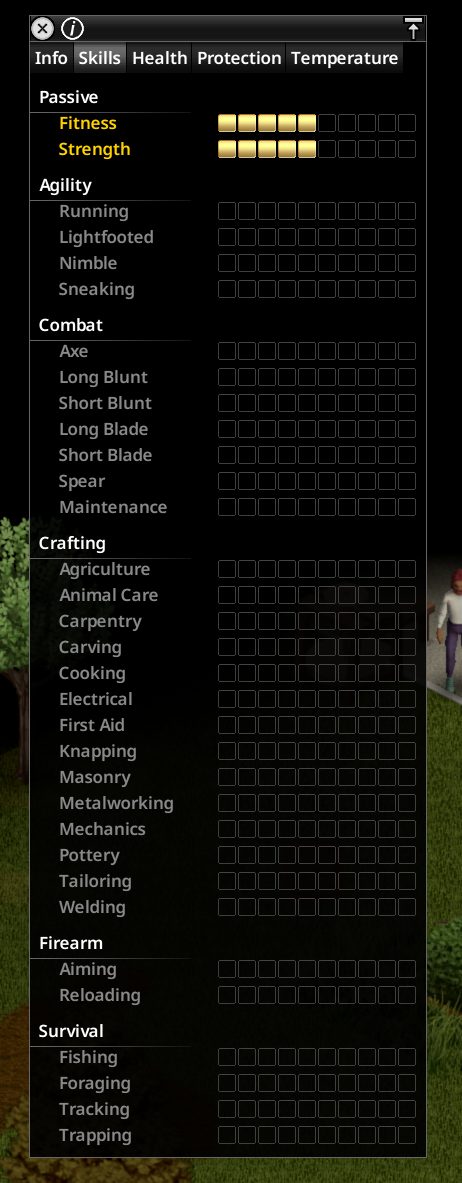
The skills panel
The skills panel · Official image, The Indie Stone

Build 42 has 35 skills. Here is what each does and how to level it.

Body

Fitness

Melee attack speed, climbing and stamina. Exercise, run with endurance, land melee hits.

Strength

Melee damage, knockback and carry weight. Exercise, carry heavy loads, chop trees.

Agility

Running

Run speed. Jog or sprint.

Lightfooted

Quieter footsteps. Move quietly near zombies.

Nimble

Speed in combat stance. Move while aiming.

Sneaking

Quieter crouching, harder to spot. Crouch near zombies unseen.

Combat

Axe, Long Blunt, Short Blunt, Long Blade, Short Blade, Spear

Attack speed, damage and less strain with that weapon type. Land hits with it.

Maintenance

Weapons wear slower. Hit with melee weapons, repair, sharpen.

Aiming

Hit chance and damage. Hit targets; XP is boosted below level 5, and shotguns hitting several zombies level it fast.

Reloading

Reload speed. Reload, with extra XP below level 5.

Crafting

Carpentry

Wooden building. Build and dismantle wood.

Cooking

Food quality. Cook.

First Aid

Treatment quality. Bandage, stitch, splint, remove glass and bullets.

Electrical

Electronics. Dismantle electronics, make electrical items.

Welding

Metal barricades and objects. Metalwork and torch dismantling.

Mechanics

Vehicle repairs. Install, remove and repair parts.

Tailoring

Clothing repair and padding. Patch and reinforce clothes.

Blacksmithing

Metal items at the forge.

Carving

Small wooden objects.

Knapping

Stone tools.

Glassmaking

Glass items.

Masonry

Brick and stone building, some pickaxe digging.

Pottery

Clay items.

Farming and wilderness

Agriculture

More crop info. Harvest crops you planted.

Animal Care

Animal info and more products. Water, feed, collect eggs, milk, shear.

Butchering

Meat quality. Process carcasses.

Fishing

Catch chance and size. Catch fish, check nets.

Trapping

Catch chance and trap recipes. Collect catches.

Foraging

Search radius and finds. Pick up forage finds.

Tracking

More clue detail. Inspect tracks.

Skill books multiply XP for two levels at a time: 3x, 5x, 8x, 12x and 16x. Aiming, Reloading and Long Blade books are weaker. Fitness, Strength, the agility skills and most weapon skills have no books.

19Step

Quick answers

Can you cure a zombie bite?

No. On default settings a bite always infects and the Knox infection always kills.

When does the water shut off?

On default settings, at a random time in the first month. Check a tap; if nothing comes out, it has happened.

What is the best starting town?

Riverside or Rosewood for a calmer start. Muldraugh has more loot and more zombies.

Which game mode should I pick first?

Rising, for a gentler start. Move to Apocalypse, the canon mode, once you can survive two weeks. Avoid Extinction until you are experienced.

Is Build 42 harder than Build 41?

Different. Build 42 adds crafting depth, animals and a much bigger map, and it is now the default version. Build 41 is still playable on the legacy41 branch.